
Nourishing Play: The Orchard at White Street Park
Story Content
What if your local neighborhood park let you pick produce while you played? At the Orchard at White Street Park, you can do just that. This one-acre public space located in Suwanee, Georgia combines natural playground elements—like an earthen mound and hillside slides—with dozens of varieties of edible fruit.
The Orchard was designed by Roger Grant, a Landscape Architect at Columbia Engineering, shortly after he moved to Suwanee in the early 2010s. Roger recognized the potential of the undeveloped park space and approached city officials about the possibility of turning it into something interesting and unique.
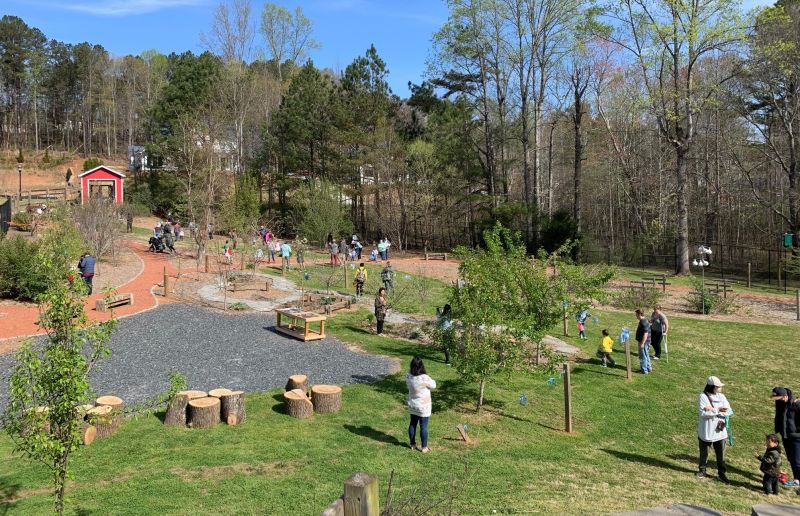
The earthen mound’s summit offers a vantage point over the Orchard’s playground elements and fruit trees.
“I wanted to combine the concepts of edible landscapes and natural playgrounds,” Roger reflects. “It’s a combination of getting kids outside and playing—which is absolutely critical—with having edible plants where you can pick the fruit and learn from that in a fun way.”
Suwanee’s City Council worked closely with Roger, providing input on the design and budget. The City financed the construction of the park and was responsible for building infrastructure, such as a pavilion, a perimeter fence, and the earthen mound. There are also children’s play features like a hand water pump, balance beams, and large hillside slides.
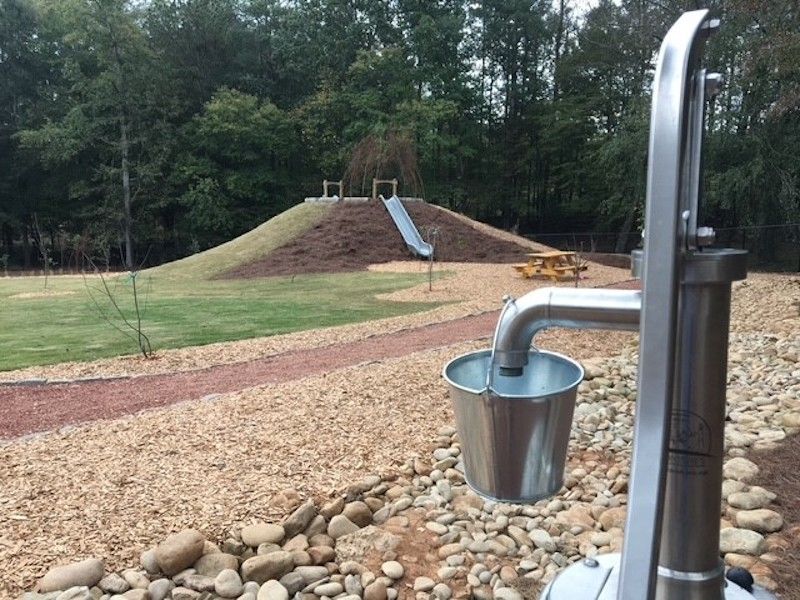
A hand water pump provides hands-on engagement and sensory exploration.
Meanwhile, the community took the lead on funding and installing the edible landscape materials. To raise financial support for the Orchard, Roger and his wife Brittany held fundraising events, including a sponsorship drive for commemorative plaques. They also led a series of volunteer days where community members helped with planting. These efforts inspired the creation of the volunteer-run Friends of the Orchard organization, which maintains the fruiting plants through activities like fertilizing, weed control, and organic spraying.
Thanks to the dedicated work of the community and the City, the Orchard was completed in 2017. The park was recognized with local awards, including the Georgia Urban Forest Council’s Outstanding New Initiative and Keep Georgia Beautiful’s Community Beautification award. These awards celebrated not only the park’s beauty, but also the strong community spirit and vision that brought the Orchard to life.
As yards get smaller and people are living in townhomes and don’t have as much landscaping they can come here and remember their childhood.
The Orchard at White Street Park now features over 75 varieties of edible fruit, including figs, blueberries, and Chinese mulberries. “I was really interested in connecting people with the food that they eat, but I wasn’t particularly interested in just annual vegetables,” Roger shares. “I really like orchard plants, I love durable fruiting plants, because they’re such long-term fixtures in the landscape and they can mature and produce more if they’re well taken care of.”
Wandering through the park to harvest fruit connects people with their roots—in more ways than one. As Roger observes, “There will be people out there picking fruit and they’ll remark how excited they are that they can go and pick these, how they had some connection to this fruit growing up. It’s really cool that as yards get smaller and people are living in townhomes and don’t have as much landscaping they can come here and remember their childhood.”
The park continues to bear fruit, with contributions from the City and local volunteers ensuring that it remains a thriving space. The Orchard has become a popular site for boy scout activities, leading to projects like bat boxes and insect hotels. There are also plans to introduce new features, like a sensory pathway. Roger looks forward to the park’s ongoing developments: “I’m enthusiastic about what they’re doing and about the future of the Orchard, knowing that there has been a good handoff to a new group of volunteers.”
Roger is currently building on his experience with the Orchard and applying what he’s learned to other parks in Georgia. One of these is Old Rucker Park in Alpharetta, which is slated to break ground in 2026 and be completed in 2027. Across these new projects, he’s eager to incorporate features such as a sensory garden, water play, sand play, and other tactile elements designed to engage visitors of all ages and abilities. “We’ll continue to refine the outdoor experience for kids and create special places they want to visit,” Roger says.
The future for natural playgrounds with edible plants is ripe with possibility. By blending nature, nourishment, and play, these spaces are creating new and exciting ways for communities to connect with each other and their environment.
Associated Case Study: The Orchard at White Street Park