About
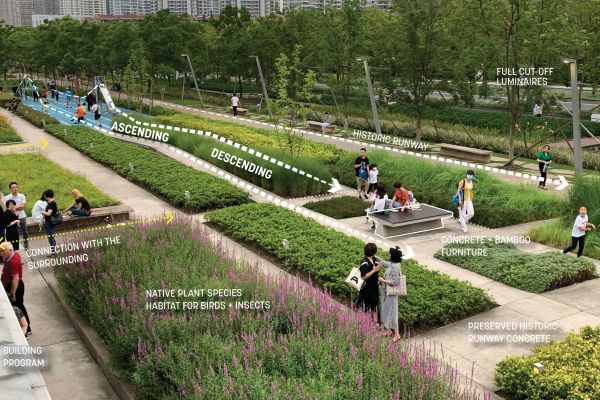
Located in Council Bluffs, Iowa, the Tom Hanafan River’s Edge Park project restored native ecology and created a green space that has become a hub of public activity. Directly across from downtown Omaha at the foot of the Bob Kerrey Pedestrian Bridge, the park offers recreational opportunities to residents of the urban area that surrounds it, including pedestrian-friendly walkways, a 2,000-seat amphitheater, and a four-acre lawn that accommodates a variety of community events. The site’s design also improves the area’s flood resilience through reforestation, swales, porous pavement, and rain gardens.
Project Details
Description
The creation of Tom Hanafan River’s Edge Park in Council Bluffs, Iowa, restored native ecology and increased the site's resilience to flooding. Formerly a poorly functioning natural area in the Missouri River floodplain with no legal public access, the area had been degraded by ATV use and invasive plants. It had also experienced partial submersion and sustained damage during the Missouri River’s 2011 Great Flood.
In the northern portion of the park, 20 acres of riparian woodland were restored through invasive species removal and reforestation with native tree species. More than 7,000 linear feet of trails now link the park to the regional trail system through the eastern landing of the Bob Kerrey Pedestrian Bridge. At the bridge landing, an open area was carved out of the forest that extends down to the water’s edge. Designed to accommodate festivals and events, this four-acre lawn also provides visitors with a view of the dramatic Omaha skyline.
The park serves not only as a destination for residents and visitors, but also as resilient infrastructure that is able to withstand a 500-year storm event. An outdoor amphitheater that can accommodate up to 2,000 visitors sits atop an existing levee. Floodplain storage capacity was increased through grading, bioswales, meadow plantings, and rain gardens. The expansive lawn area was constructed with a customized soil profile that increases infiltration during rain and flooding events.
Project Goals
- Ensure that park land and amenities in the floodplain will be resilient for up to a 500-year flood event.
- Provide access to 85 acres of waterfront open space for people from the city and region to have a point of connection — visually, physically, and emotionally — to the Missouri River, where none had previously existed.
- Provide new outdoor space for events and recreational public use.
- Protect the existing flood protection levee while minimizing its impact as a barrier to waterfront access.
- Capitalize on the viewsheds towards the Missouri River and Omaha’s skyline.
- Provide an appropriately grand and inviting destination at the landing to the Bob Kerrey Pedestrian Bridge, connecting the park to a larger trail network.
- Revitalize the riparian forest on the northern and southern portions of the site.
Reprinted from the original LAF LPS case study.
Social Benefits
- Increases levels of outdoor activity for 68% of 47 surveyed users.
- Improves perception of safety for 84% of 37 surveyed users.
- Increases ease of access to the Missouri River according to 89% of 35 surveyed users.
Reprinted from the original LAF LPS case study.
Contact Landscape Architect – Sasaki info@sasaki.com Sasaki Tom Hanafan River’s Edge Park – Sasaki
Project Team
Client: City of Council Bluffs Department of Parks, Recreation and Public Property
Landscape Architect: Sasaki
Civil Engineering: HGM Associates, Inc.; Sasaki Associates, Inc.
Electrical/Communications: Alvine Engineering, Inc.
Structural Engineering: Richmond So Engineering, Inc.
Total Cost
Budget: $11.5 million
Awards
Omaha By Design: Environment & Open Space Award
City of Council Bluffs: Honor Award for Engineering Excellence