About
Located in a former industrial zone along the Xuhui riverfront in Shanghai, China, Xuhui Runway Park is a 36-acre public space that includes a street and linear park on the site of a former airport runway. The innovative design preserves pieces of the site's aviation history while offering diverse opportunities for outdoor recreation, gatherings, performances, and public events. The park, which is surrounded by high-density mixed-use developments, includes gardens, lawns, and seating areas, as well as options for vehicle, bicycle, and pedestrian traffic. It is mainland China's first SITES Gold project. SITES is a collaborative, interdisciplinary effort by the American Society of Landscape Architects and other groups that provides a comprehensive framework for designing, developing, and managing sustainable and resilient landscapes and other outdoor spaces.
Project Details
Description
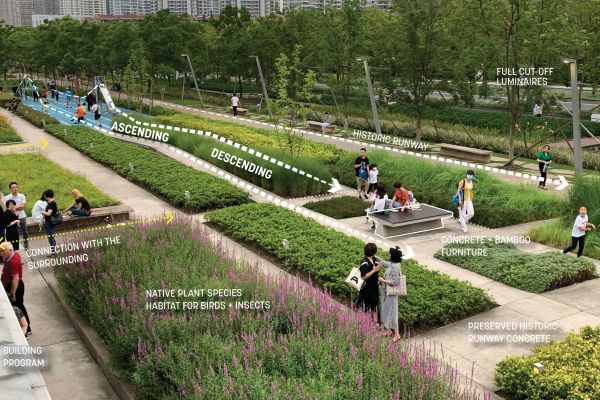
Designed as a side-by-side public street and linear park, Xuhui Runway Park in Shanghai, China, sits on the site of a former airport runway. A model for sustainable urban park design, the project transformed a barren concrete expanse into a human-scaled boulevard that offers residents and visitors access to a variety of green spaces. Designated areas for bicycles and pedestrians reduce vehicle traffic by encouraging "green" commuting. The design preserves pieces of the site's aviation history with features such as ascending and descending areas that mimic the motion of planes taking off and landing, slanted light posts that resemble airplane wings, aviation-inspired water features, and the reuse of part of the former concrete runway as the main pedestrian path.
Surrounded by high-density mixed-use developments along the Xuhui riverfront, this innovative urban revitalization project incorporates tree-lined streets and paths that offer welcoming shade and mitigate the urban heat island effect. Themed plantings include a birdwatching garden, pollinator gardens, butterfly grove, and rain gardens. The site was planted with 82 species of plants, including 2,227 trees, all native to the Yangtze River Delta. Stormwater runoff is managed via rain gardens and constructed wetlands, which reduce river pollution and flood impact by storing and cleaning rainwater via plant root absorption and soil filtration. These areas also create important habitats for birds, insects, and other wildlife. Water from the 10,408-gallon underground cistern is used to irrigate almost five acres of planted areas. A sunken garden that can accommodate up to 900 people offers a venue for cultural events and performances, while a multipurpose lawn can host events for up to 3,500 people.
Xuhui Runway Park’s green infrastructure and sustainable initiatives earned it the first SITES Gold certification in Mainland China. SITES is a collaborative, interdisciplinary effort by the American Society of Landscape Architects and other groups that provides a comprehensive framework for designing, developing, and managing sustainable and resilient landscapes and other outdoor spaces. The project also earned the 2021ASLA Honor Award, Urban Design.
Project Goals
- Connect park visitors visually and physically to the site’s aviation history.
- Facilitate a green commute by connecting people to their destinations with a pleasant place to pass through, providing bicycle infrastructure, and fulfilling “last mile” needs for commuters between transit (the subway) and their individual destinations.
- Promote active lifestyles by making use of multiple forms of “runway,” including bike and pedestrian pathways, the runway playground, interactive fountains, and multipurpose lawn.
- Develop a universally accessible place where people at a full range of ability levels share equal opportunity to experience the park.
- Manage stormwater from Yunjin Road and the park.
- Create wildlife habitats for both land and marine typologies of flora and fauna, especially species native to Yangtze River Delta.
- Mitigate urban heat island effect in a dense post-industrial site while mitigating air pollution and noise generated by Yunjin Road.
- Minimize electricity and water usage within the park.
- Create additional commercial frontage along the garden perimeters and bring more revenue to the park to support its operation and maintenance costs.
- Raise property values in the neighborhood.
Reprinted from the original LAF LPS case study.
Social Benefits
- Offers more than 32 types of activities for park users. Walking is the most common type of activity in the park, with 73% of 263 surveyed park users reporting that they often walk in the park. 65% reported that they often drink coffee in the park, while 61% of surveyed users reported that they socialize with family or friends.
- Supports social interaction, with 81% of 263 surveyed site users reporting that they usually go to the park with their family members, friends, or colleagues.
- Supports awareness of the site’s aviation history, with 73% of 263 surveyed park users reporting their awareness that the park was transformed from the former Longhua Airport runway.
- Reduces stress according to 85% of 263 surveyed park users who reported that spending time in the park has a positive effect on stress relief.
- Improves quality of life according to 81% of 263 surveyed park users.
- Creates feelings of safety according to 84% of 263 surveyed park users who said they felt relatively or very safe when in the park.
- Reduces average noise levels from 73.9 decibels on the east side of the park where Yunjin Road is located to 61.0 decibels on the west side of the park, achieving a clearly noticeable reduction and noise buffer from the road.
- Supports high rates of satisfaction with the park for 84% of 263 surveyed park users.
Reprinted from the original LAF LPS case study.
Contact Landscape Architect – Sasaki info@sasaki.com tzhou@sasaki.com Sasaki Xuhui Runway Park
Project Team
Landscape Architect: Sasaki
Lighting Design Consultant: Leni Schwendinger Light Projects Ltd.; Arcplus Group Co. Ltd.
Fountain Design Consultant: Fluidity Design
Structural, Civil, and Electrical Engineer: Shanghai Municipal Engineering Design Institute (Group) Co., Ltd.
Architect: Scenic Architecture Office
Signage Design: Sasaki
General Constructor: Shanghai Gardening-Landscaping Construction Co. Ltd.
Total Cost
Budget: $28.5 million USD
Awards
USGBC Massachusetts Chapter: SITE Green Building Market Leader - Site, 2019
ASLA: Honor Award for Urban Design, 2021
Boston Society of Landscape Architects: Honor Award, 2021
IFLA Asia-Pacific: Award of Excellence, 2020
World Landscape Architecture: Merit Award in Built – Large category, 2021
Design for Asia: Merit Award, 2020
MIPIM Asia Awards: Best Urban Regeneration Project, Silver, 2020
The Plan: Landscape Honorable Mention, 2020
Word Architecture Festival: Landscape - Urban Context, 2021
Fast Company: Innovation by Design Award, Honorable Mention, 2020